In the mini-game Bowser's Big Blast from Mario Party 2 and Mario Party Superstars, players select a switch one at a time. Exactly one switch triggers a bomb, the others are safe. When starting with \(4\) players there are \(5\) switches. Whoever presses first loses by \(20\,\%\) ; The last person standing in front of only \(2\) switches has \(50\,\%\) . Nevertheless, the last place does not have a higher probability of loss. The apparent contradiction arises because we compare probabilities at different points in time.
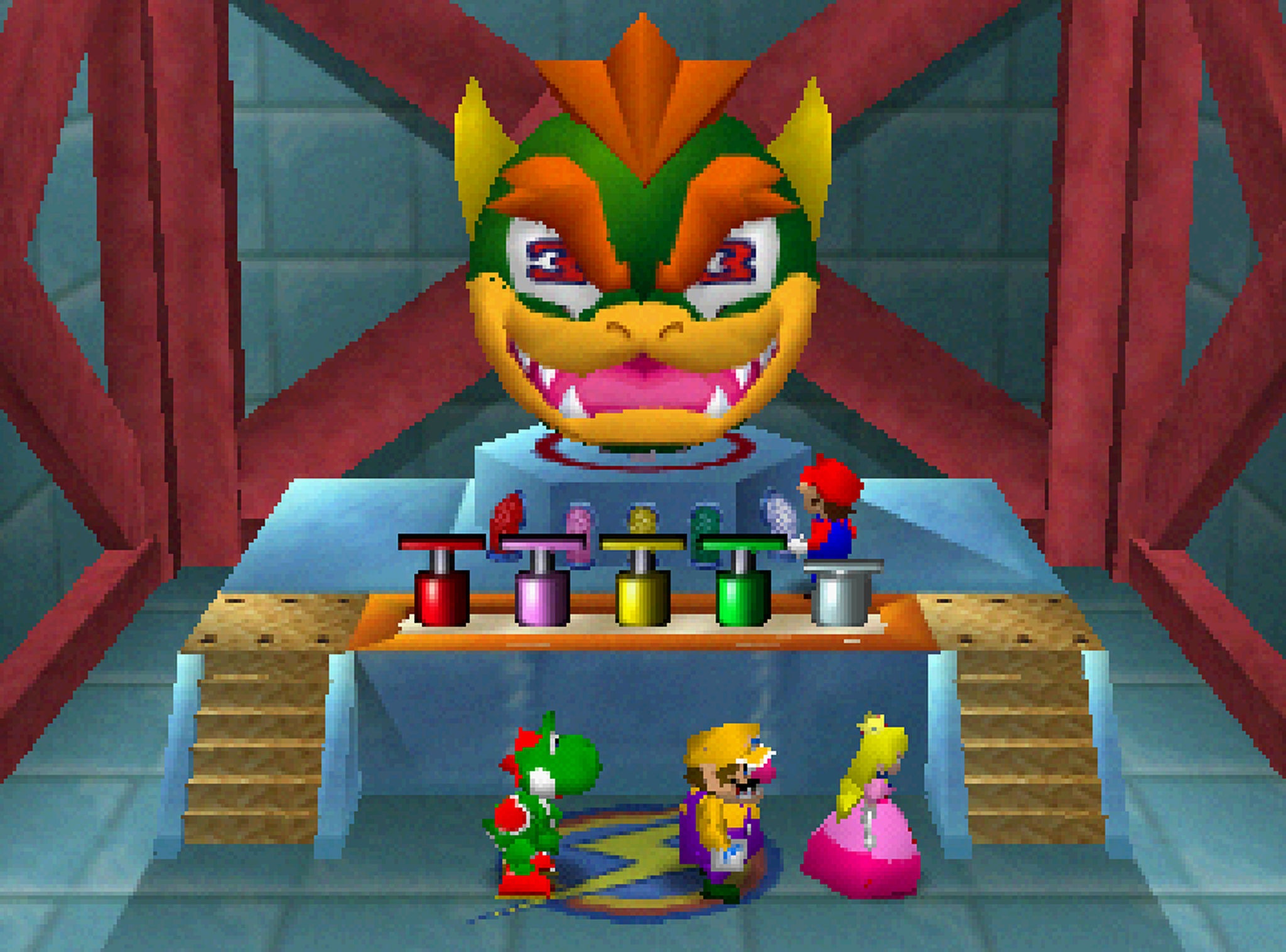
We assume that the detonator is evenly distributed among the free switches and is not detectable. The last player only gets his turn if the first \(3\) players have pressed safely, i.e. the bomb has not exploded. The chance of this is \(\frac{4}{5}\cdot\frac{3}{4}\cdot\frac{2}{3}=\frac{2}{5}=40\,\%\) . In the remaining \(60\,\%\) the round ends beforehand. If you multiply the chance of even getting a turn by the subsequent risk, you get the same \(20\,\%\) as for the first player. This results in the last position:
$$\frac45\cdot\frac34\cdot\frac23\cdot\frac12=\frac15=20\,\%.$$
By \(q\) we denote the probability that a given player is the next to be eliminated, even after any number of repetitions. In the first round there are three cases: With \(1/5\) it hits this player. With \(3/5\) it hits one of the others; our player will then not be eliminated next. With \(1/5\) everyone survives and the switches are reset. Afterwards the situation remains unchanged, so the desired chance is again \(q\) . That's why it applies:
$$\begin{aligned}q&=\frac15+\frac15q,\\\frac45q&=\frac15\quad\Longrightarrow\quad q=\frac14.\end{aligned}$$
After the next elimination, the remaining players start again on equal terms. The chance of surviving until then is \(3/4\) when starting with \(4\) players, then with \(3\) players \(2/3\) and finally with \(2\) players \(1/2\) . If you multiply these conditional chances of survival, you get \(25\,\%\) chance of winning for the first and last starting positions. In general, with \(n\) players, everyone wins with \(1/n\) . Colors don't help in the fair model. For the overall victory follows:
$$P(\text{Sieg})=\frac34\cdot\frac23\cdot\frac12=\frac14=25\,\%.$$
Bowser's Big Blast – Spiel und Wahrscheinlichkeiten von David Vielhuber auf CodePen.