At Who Wants to Be a Millionaire there was recently a nice little question that Günther Jauch clearly had to think about: “A number is always divisible by \(4\) without a remainder if the number formed from its last two digits...?” – and this is exactly where you have to think mathematically for a moment instead of letting yourself be lured by the pretty distractions. Because while answers like “is even”, “contains a \(0\) ” or “the cross sum equals \(4\) ” sound plausible at first glance, the correct answer is based on a simple property of our decimal system.
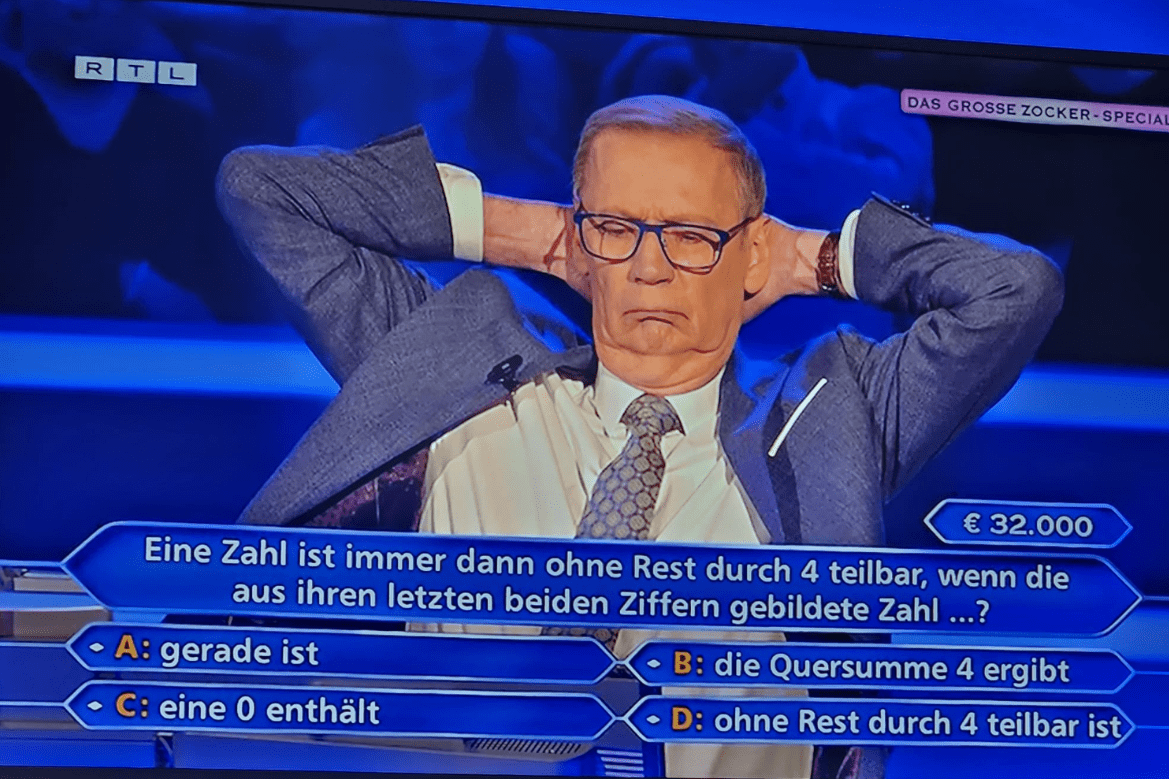
A number \(X\) is divisible by \(4\) if and only if the number formed by its last two digits is divisible by \(4\) . The proof follows directly from the decimal representation. Every natural number \(X\) can be uniquely represented in the form
\[
X = 100 \cdot X' + X''
\]
write where \(X''\) is the number formed from the last two digits, i.e., \(0 \leq X'' < 100\) , and \(X'\) is the preceding part of the number. Since
\[
100 = 25 \cdot 4
\]
applies, follows
\[
X = 25 \cdot 4 \cdot X' + X''.
\]
The first addend \(25 \cdot 4 \cdot X'\) is always divisible by \(4\) regardless of \(X'\) . Therefore, for the remainder of \(X\) when divided by \(4\) only \(X''\) is relevant. Formally expressed:
\[
X \equiv X'' \pmod{4}.
\]
This applies in particular:
\[
4 \mid X \iff 4 \mid X''.
\]
Similar divisibility rules arise whenever a power of \(10\) modulo a number becomes particularly simple. For divisibility by \(4\) the crucial factor was that \(100 \equiv 0 \pmod 4\) It becomes even more interesting when the values \(1\) or \(-1\) occur instead of \(0\) .
A classic example is divisibility by \(11\) .
\[
10 \equiv -1 \pmod{11}
\]
If this is true, the place values of a decimal number modulo \(11\) always alternate between \(1\) and \(-1\) .
\[
X = a_0 + 10a_1 + 10^2a_2 + 10^3a_3 + \dots
\]
It therefore follows
\[
X \equiv a_0 - a_1 + a_2 - a_3 + \dots \pmod{11}.
\]
A number is divisible by \(11\) if and only if the sum of its alternating digits is divisible by \(11\) For \(918082\) for example, this is the case.
\[
2 - 8 + 0 - 8 + 1 - 9 = -22,
\]
and since \(-22\) is divisible by \(11\) , \(918082\) is also divisible by \(11\) .
Even more elegant is the rule for \(7\) , \(11\) and \(13\) simultaneously. It holds that
\[
1001 = 7 \cdot 11 \cdot 13
\]
and thus
\[
1000 \equiv -1 \pmod{7}, \qquad
1000 \equiv -1 \pmod{11}, \qquad
1000 \equiv -1 \pmod{13}.
\]
If you divide a number into blocks of three from right to left, you can therefore add and subtract these blocks alternately. For
\[
X = 123456789
\]
So, if one considers
\[
789 - 456 + 123 = 456.
\]
The original number has the same remainder modulo \(7\) , \(11\) and \(13\) as \(456\) Therefore, a very large number can be replaced by a significantly smaller one without changing its divisibility by these three numbers.
Divisibility by \(37\) also has a surprisingly elegant form. Since
\[
999 = 27 \cdot 37
\]
applies
\[
1000 \equiv 1 \pmod{37}.
\]
When divisible by \(37\) the blocks of three can simply be added together. For example, from
\[
99937
\]
the sum
\[
99 + 937 = 1036.
\]
There
\[
1036 = 28 \cdot 37
\]
If \(99937\) is divisible by 37, then 99937 is also divisible by \(37\) .
Such rules initially appear to be numerical tricks, but are ultimately just applications of the same idea: replacing large powers of ten with simple remainders modulo the number in question. This transforms a large decimal number into a simple calculation involving congruences. That's precisely why such divisibility rules are more than mere arithmetic tricks; they represent a reduction to remainders modulo \(10^k\): In quiz format, they appear as small cognitive traps, but lead directly to a surprisingly elegant idea in number theory.