Amazon is the perfect shopping channel for freelancers: fast, affordable, and everything in one place. Amazon has now managed to consistently provide timely and readily available invoices for download (even for purchases on the Marketplace). Whether it's a new laptop, an office chair, or just a quick order of printer paper – the goods can be ordered with just a few clicks, usually via the personal account that you've had for years anyway.
Most Amazon invoices look perfectly correct at first glance: German seller name, German address (e.g., Munich), 19% VAT shown. The catch lies in a detail that is easily overlooked: the seller's VAT identification number (VAT ID). If it says, for example, "LU…", the invoice issuer is registered for VAT in Luxembourg – typical for Amazon companies like "Amazon EU S.à r.l.":
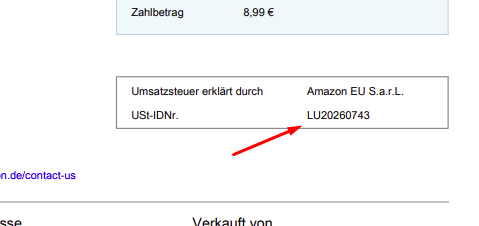
From the perspective of German VAT law, this is often not a normal domestic purchase, but falls under the category of intra-Community acquisition (goods come to Germany from an EU member state). For B2B purchases within the EU, a net invoice (0% VAT) is typically issued, and the acquisition is taxed in Germany via the preliminary VAT return (acquisition tax + input tax deduction if the recipient is entitled to deduct input tax).
If Amazon charges VAT even though your business should be exempt from VAT on intra-community supplies, this VAT cannot be claimed as input tax. If, instead, you receive a standard 19% VAT invoice, even though the seller is located in another EU country and you purchased as a business, this is precisely the situation that will later cause unnecessary problems during a tax audit.
Amazon Business provides a streamlined mechanism for using Amazon in the B2B sector. This primarily involves registering your VAT ID number so that Amazon orders are correctly treated as business purchases – including invoicing logic. Amazon itself states that for business purchases, you should enter your VAT information or VAT ID number in your account to ensure the correct tax rate and VAT handling are applied.
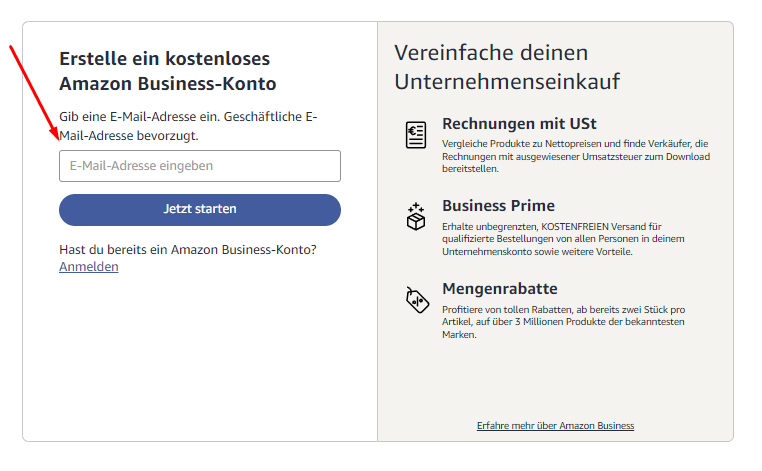
A business account is free, and you can create a separate business account with its own email address from your personal account and link the two accounts. All non-business items can also be purchased through the business account. There are occasional discounted business items, you only see net prices, and you can hide sellers who don't issue invoices.
In addition, there's a net price display (helpful for comparing purchases, since as someone eligible for input tax deduction, you're interested in the net price), invoices tend to be more consistently retrievable/assignable (especially because the "Business" version focuses more on this aspect of the processes), and optional interfaces/integrations with accounting systems are available. You can even create a business account directly from your personal account.:
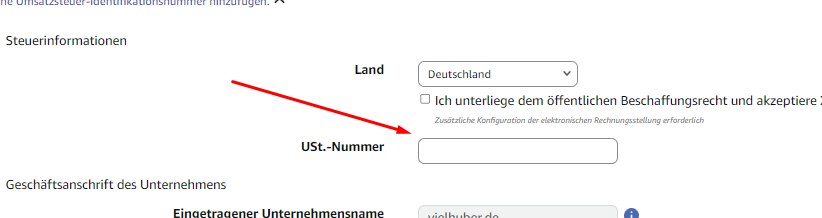
Finally, a VAT ID number is entered in the business profile.:
You can't use Amazon Prime Video or Amazon Music with a business account – that's only possible with a personal account. However, if you want to use Amazon Prime for free shipping with your business account, you can link it to your personal account ( Prime Duo ) free of charge and avoid paying twice. This way, you secure fast, free shipping for your company, while movies and music continue to be accessed through your personal profile.
Also important to mention, and something many self-employed people underestimate when switching providers: As a business customer, you don't have the same statutory 14-day right of withdrawal as consumers (exceptions may be made on a goodwill basis only in rare cases). As a business customer, you are not automatically legally in the same position as a consumer. The well-known 14-day right of withdrawal for distance selling generally only applies to consumers.
While private individuals can return goods without giving a reason, the law does not provide for this right in the B2B sector. Returns and cancellations are then primarily a matter of contract (i.e., what Amazon or the respective seller promises in their terms and conditions). Although Amazon is generally known for its customer-friendliness and often accepts returns from business customers, this is purely a courtesy.